 French manufacture 💧 Ethical & Authentic Care ✨ Natural care for all skins 💚 Wellness boxes made on the farm with love 🎁 Gift boxes 🌿 Natural routins
Cold saponification: much more than a method, a true passion
For me, cold saponification is not a simple manufacturing technique. It's a way to create otherwise. A way to take care of the skin, to respect the environment more and to give life to artisanal soaps that each have their own personality.
When I make soap, I'm not just trying to get a washing product. I want to create a pleasant, gentle skin care, and faithful to my values. That's exactly why cold saponification I'm so passionate.

Why cold saponification speaks so much to me
I like cold saponification Because she brings all that matters to me.
First, it is part of a more artisanal and respectful approach. Working with natural ingredients, some of which come directly from my farm, I remain consistent with how I produce and consume.
Then this method allows me to make soaps that are not just nice or pleasant to use. They also bring comfort to the skin. And for me, that changes everything.
Finally, cold saponification leaves a real place for creativity. Every marbling, every color, every movement in the dough tells something. That's where soap becomes almost a unique piece.
The benefits of cold saponification for the skin
If cold saponification seduced as much, it's no coincidence.
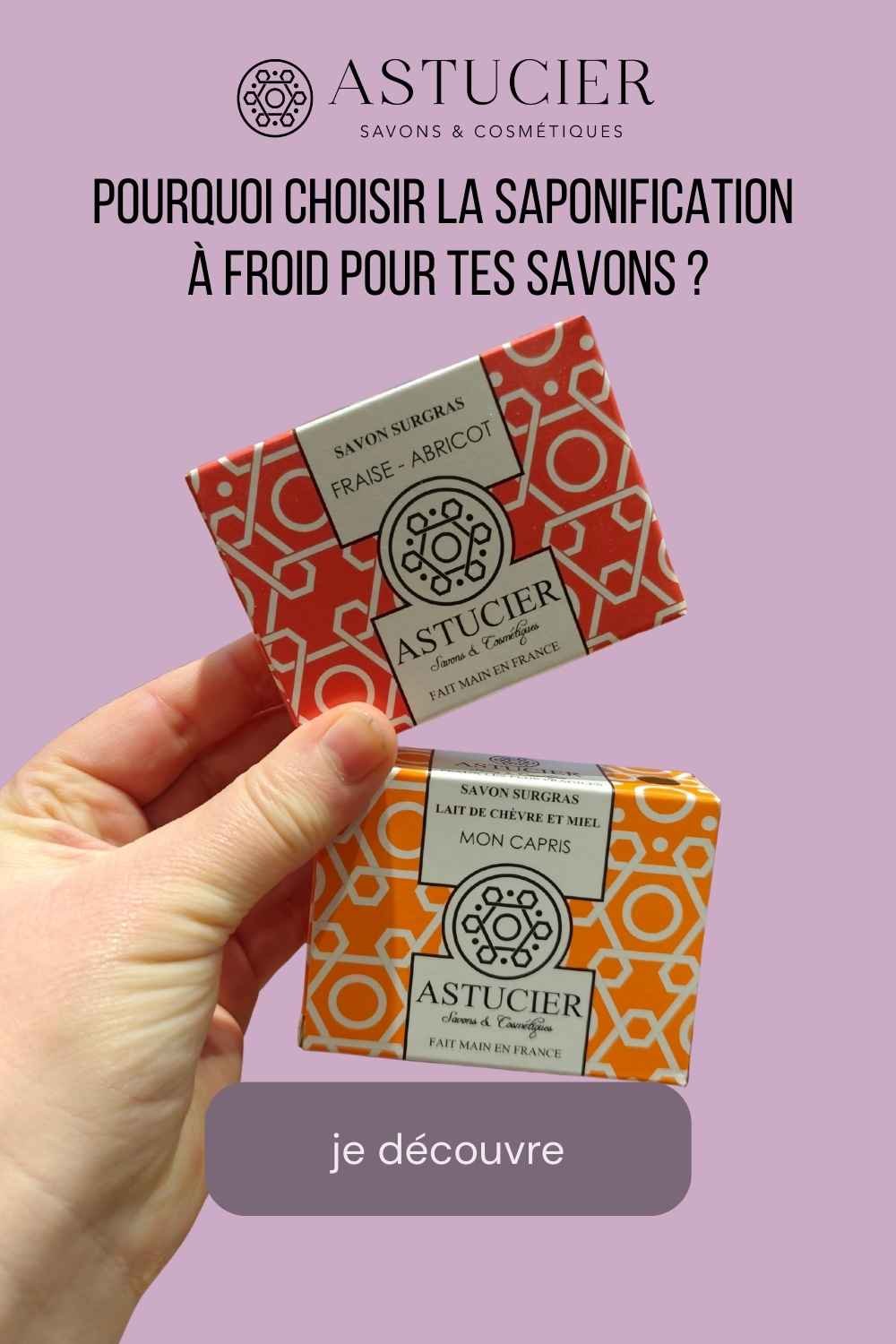
This method preserves the qualities of the oils used in the recipe. The result: soap cleans, but it does not just wash. It also accompanies the skin with more softness.
I particularly appreciate this, because my soaps are overgras. This means that some of the oils remain available to provide more comfort to the skin. The hydrolipidic film is better respected, and the skin often pulls less after the shower.
That's what I'm looking for in a soap: a simple, efficient and enjoyable product to use every day.
Cold saponification, a more respectful approach
Choose cold saponificationIt is also a choice of craft manufacturing that makes sense.
This method naturally accords with human-sized production. It requires time, precision and real involvement. We are far from standardized and impersonal manufacturing.
For me, it's important. I want to make soaps that reflect my work, my universe and my convictions. Use carefully selected raw materials, limit the useless, value what I produce on the farm: all this is part of the story I want to tell through I know.
Marbling art: when cold saponification becomes creative
What makes me vibrate in cold saponificationIt is also its artistic dimension.
Soap is not only useful. It can also be beautiful. The marbling transforms each manufacture into a field of expression. I love this moment when colors meet, mix, respond... I don't always know exactly what I'm going to get.
And that's exactly what I like.
Marbling art: when cold saponification becomes creative
What makes me vibrate in cold saponificationIt is also its artistic dimension.
Soap is not only useful. It can also be beautiful. The marbling transforms each manufacture into a field of expression. I love this moment when colors meet, mix, respond... I don't always know exactly what I'm going to get.
And that's exactly what I like.
The marbling one pot
It's a technique that I often use. I gather several colors of dough in the same container before pouring it all into the mould. The result is still a little unpredictable.
It's a living, spontaneous method full of surprises. Sometimes the rendering bluffs me. Sometimes he surprises me differently. But he never gives way to boredom.
The wand marbling
Here, pastas of different colours are placed side by side, then delicately worked with a baguette. This creates more structured drawings, often more symmetrical.
I use it less often, especially because my mussels don't always lend themselves to it. But the result can be really elegant.
Layered marbling
This technique consists of superimposing several layers of colours in the mould. It allows to create a graphic soap, visual, with nice transitions.
This is especially what I use for soap Wheat Germ.
The hanger marbling
The principle is simple: after creating several layers, I pass a hanger into the dough to trace delicate movements between the colors. This gives finer, more wavy, almost poetic patterns.
The Funnel
With this technique, I pour the colors one at the center of the other to form rounded patterns. The rendering can then be further worked on to create even more original effects, sometimes close to a spider web.
Inserts
I also like to incorporate soap pieces already made in a new creation. This brings relief, contrast and an even more artisanal touch. This technique is found in some Christmas soaps or soap Apple of Love.


Why I love cold saponification so much
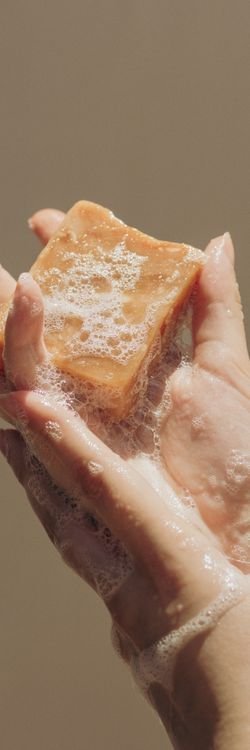
I like cold saponification because it allows me to bring together in a single gesture everything that mingles: care, authenticity, creativity and respect for what surrounds us.
When you choose cold saponified soap, you don't just choose a product to wash yourself. You choose a carefully made soap. You choose a craft method. You choose a care that can bring more softness to your skin. And you also choose a whole universe.
It is this complete dimension that still fascinates me today.
In conclusion
Cold saponification allows me to create soaps that make sense. Soaps designed to be pleasant to use, softer for the skin, and bear a true artisanal identity.
It's a demanding method, but it's also what makes it so beautiful.
And very sincerely, that's exactly what makes me vibrate in my profession.